
Four Minutes After the Ropes Came Down: The Hindenburg at Lakehurst
How the largest airship ever built arrived hours late at a rain-soaked New Jersey field on 6 May 1937, burned to its skeleton in under a minute, and took the age of the passenger Zeppelin with it.
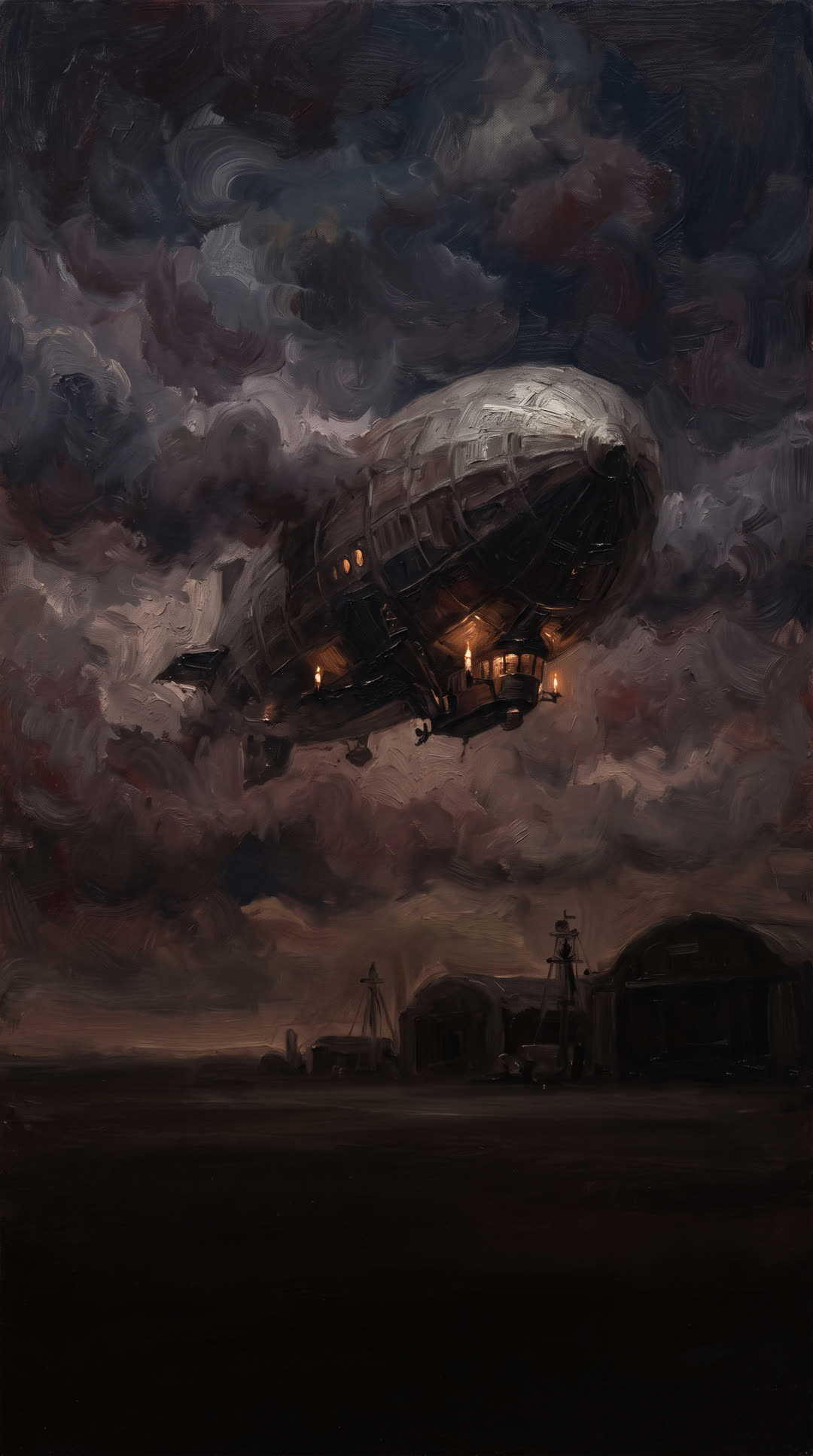
The evening of 6 May 1937 was supposed to be routine, even a little celebratory. The German airship Hindenburg was drifting in toward the landing field at Lakehurst Naval Air Station in New Jersey, southwest of New York City, at the end of a crossing from Germany 5. It was running hours behind schedule. Headwinds over the Atlantic had slowed the ship, and then storms along the American East Coast delayed the landing further, so that by the time the Hindenburg finally came in the sky was darkening and it was around seven in the evening 5.
The weather had already disrupted the arrival once. The ground handling party should have been in place for the earlier scheduled landing; they were not, and had to be gathered again as the ship returned after the storms passed 5. One man who had stayed put was Herb Morrison, a 31-year-old radio announcer from WLS in Chicago, an affiliate of the National Broadcasting Company, who waited rain-soaked with his microphone to interview the well-to-do passengers as they disembarked 5. With him was sound engineer Charlie Nehlsen; the two intended to produce an air-travel publicity piece marking the one-year anniversary of the Hindenburg's transatlantic service, recording onto disc for later broadcast rather than going out live 54.
The ship itself carried a political weight beyond its passengers. Contemporary accounts described the Hindenburg as the largest dirigible ever built and the pride of Nazi Germany 3. Between the world wars, when air travel was still a novelty, globetrotting Zeppelins were a big to-do, and passengers rode in style across an ocean that ships took days to cross 5.
The scale of the Hindenburg is hard to grasp from photographs. The Library of Congress essay on the disaster describes the ship as nearly three football fields long, the grandest of its class, and calls it the Titanic of the airships 5. PBS similarly identifies it as the world's largest airship 2. What held that enormous hull in the air was hydrogen gas: roughly seven million cubic feet of it, stored in sixteen gas cells, giant bags that filled the ship from end to end 4.
Hydrogen is lighter than air, which is why it lifts, and it is also flammable, which is why every landing carried a risk that passengers largely chose to ignore. The Library of Congress essay puts the paradox plainly: travellers floated in style, defying the odds, in balloons filled with lighter-than-air flammable hydrogen 5. The Hindenburg's passengers that evening numbered among 97 people aboard, passengers and crew combined 24. Among them was Ernst Lehmann, an experienced Zeppelin captain travelling aboard, who, according to PBS, hoped to prevent a potential disaster 2.
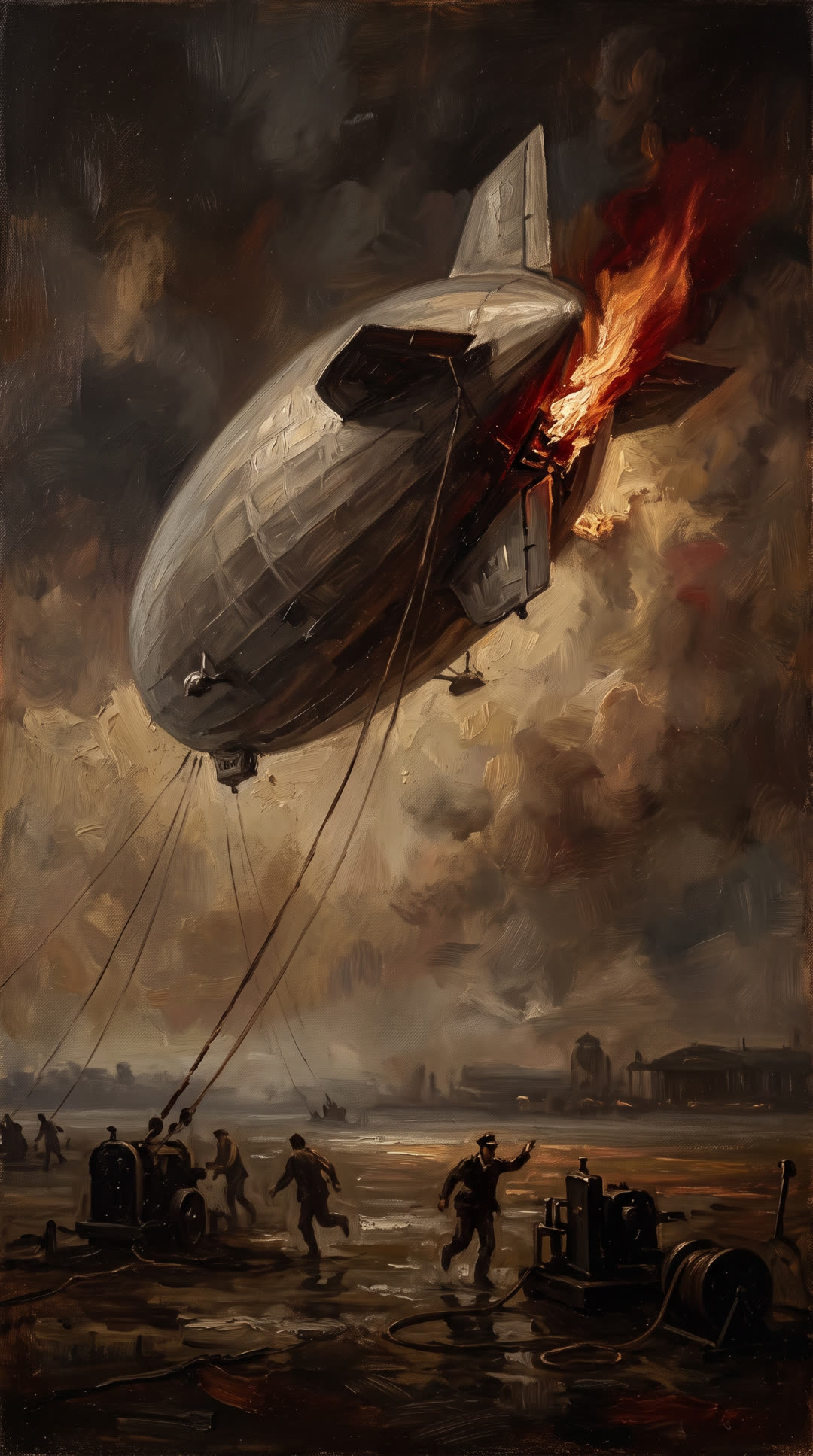
As the ship hovered over the field, the crew dropped the landing lines. They reached the rain-soaked ground, and ground handlers moved to take them 2. For about four minutes, nothing seemed amiss. Morrison narrated calmly into his recorder, describing the ship coming out past the hangar and the approach to the mast 45.
Then, roughly four minutes after the first landing ropes touched the wet ground, fire erupted 24. The flame appeared toward the stern of the ship, in the region the later NOVA investigation examined when it studied how the outer skin was attached to the frame 4. Exactly what lit the hydrogen has never been settled. PBS states that even today no one knows whether lightning or a static spark caused the gas to ignite 2. The Library of Congress essay summarises the official conclusion: because of a hidden design flaw, the airship had sprung a hydrogen leak, and in an atmosphere thick with passing storms and electrical charges, the leaking gas caught fire 5. An amateur film shot by Harold Schenck has been analysed for clues, but it did not show how the hydrogen ignited 4.
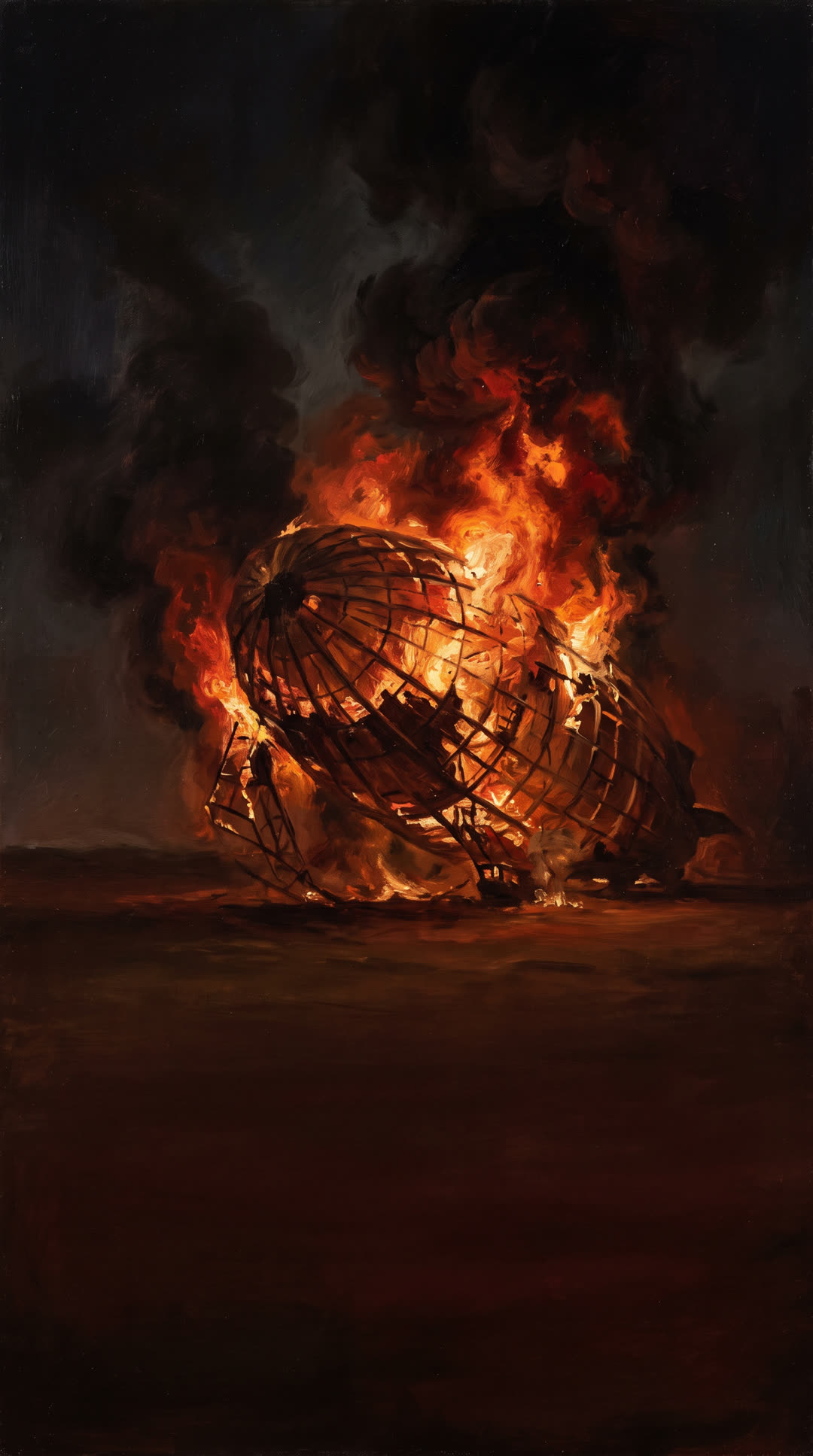
What followed was not a long fire. The seven million cubic feet of hydrogen burned through the ship almost instantaneously, and in less than a minute the Hindenburg and the 97 people aboard were enveloped in what PBS calls a gigantic fireball 2. History.com describes the hull rapidly falling about 200 feet to the ground and incinerating within seconds 3. The NOVA narration is blunter still: in less than a minute, there was nothing left but smoking wreckage 4. The Library of Congress essay agrees that the ship was gone in less than a minute 5.
Morrison, standing on the muddy field, was engulfed by the heat and glow of the burning ship. His suit was toasted, and, overcome by the blast, he began hyperventilating into the microphone even as he kept talking: It's burst into flames . . . It's a terrific crash, ladies and gentlemen . . . The smoke and the flames now . . . Oh, the humanity! 5. Those words, recorded on a lacquer disc that was never meant to carry breaking news, became the most famous spontaneous account of the disaster 5.
Newsreel cameras were rolling too. PBS says the entire disaster was caught on film 2, and the Smithsonian preserves silent footage of the ship bursting into flames while landing, footage that was once shown in the National Air and Space Museum's Balloons and Airships exhibition 1. There is a nuance, though. The cameras captured the fire's spread and the collapse, but none of the known films, including Schenck's, recorded how the hydrogen first ignited 4. The pictures begin, in effect, a few seconds into the catastrophe.
The casualty figures have been repeated so often that they are easy to misremember. Of the 97 passengers and crew aboard, 35 died; one member of the ground crew was also killed, bringing the total to 36 4. Some of the dead were killed instantly, while others died later of their injuries 2. Ernst Lehmann, the veteran captain travelling aboard, died the day after the crash 2.
Yet the more remarkable number is the other one. Sixty-two passengers and crew members made it out of the fireball alive, which PBS calls miraculous 2. The Library of Congress essay stresses the same point: most of the 97 aboard, remarkably, survived 5. The combination of the ship settling toward the ground as it burned and the sheer speed of the fire meant that many people were close enough to the earth to get clear before the structure collapsed on top of them. The disaster is remembered as a slaughter, but it was, statistically, a catastrophe that two-thirds of those aboard lived through 25.
Morrison's recording was not heard that night. His account was not broadcast live; it was carried back and aired afterwards, and the Library of Congress essay notes that without the flight delay and some deft needlework, the priceless recording might never have happened at all 5. In 2002 the recording was added to the National Recording Registry of the Library of Congress, which describes it as the most stunning and dramatic radio broadcast of all time 5. Combined with the newsreel footage, it gave the world a disaster it could both see and hear, something almost unprecedented in 1937.
The commercial consequences were swift and permanent. The Zeppelin company made design changes to the way the outer skin attached to the frame of its remaining ship, but, as NOVA puts it, it didn't matter 4. After the Hindenburg disaster, no rigid airship ever carried a paying passenger again 4. The technology had already been overtaken: by the time the Hindenburg first left its hangar, aeroplanes could do many of the same things better 4. The fire at Lakehurst did not kill a thriving industry so much as it closed one that was already living on borrowed time.
The physical remains are small. Various objects and a piece of fabric from the Hindenburg are displayed at the Smithsonian's Steven F. Udvar-Hazy Center, and a model of the airship, originally built for the Universal City Studios film about the ship's final flight, now hangs in front of the museum store in Washington, D.C. 1.
Strip away the legends and the story is stark enough. A ship nearly three football fields long, filled with seven million cubic feet of hydrogen, arrived hours late at Lakehurst in stormy weather on the evening of 6 May 1937 54. About four minutes after her landing ropes reached the wet ground, she caught fire, and in less than a minute she was wreckage 24. Thirty-six people died, 35 of them aboard and one on the ground, while 62 survived 42.
The exact spark remains unknown, and the question of why hydrogen was leaking has never been fully answered 25. What is certain is that the cameras, and one shaken radio announcer from Chicago, turned a single minute in New Jersey into the moment the age of the passenger airship ended 54. This was the Hindenburg disaster of 1937.
What we know vs. legend
What we know: both the investigation summary cited by the Library of Congress and PBS attribute the fire to leaking hydrogen ignited by electrical activity in the stormy air 52. Legend: that the ship was sabotaged by a bomb. No inquiry found evidence for this; the sabotage story was popularised by the Universal City Studios film, whose props and control-cabin mockup were later displayed alongside genuine Hindenburg artifacts at the Smithsonian, which has helped the narrative persist 1.
What we know: sources loosely say the Hindenburg 'exploded' 25, but the destruction they describe is a fire that consumed the ship in less than a minute 24. Legend: a single detonation. The ship burned extremely fast; it did not blow apart in an instant.
What we know: the ship was hovering with its landing lines on the ground when fire broke out, about four minutes after the ropes came down 24. Legend: History.com's phrasing that the ship burst into flames 'upon touching its mooring mast' 3 is loose; the fire began during the mooring approach, not on contact with the mast.
What we know: Morrison's description was recorded for later broadcast and was not aired live 54. Legend: that listeners heard 'Oh, the humanity!' as it happened. They did not; the famous combined picture-and-sound version was assembled afterwards.
What we know: 62 of 97 people aboard survived 2. Legend: that most people on board died. The 36 dead include one ground crewman, and roughly two-thirds of those aboard lived 4.
What we know: PBS says the entire disaster was caught on film 2, and footage of the burning ship survives 1. Legend: that the cameras recorded the exact moment of ignition. The films, including Harold Schenck's amateur footage, do not show how the hydrogen ignited 4.
What we know: the disaster occurred on 6 May 1937 15. Legend-level error: the History.com video text gives the date as May 3, 1937 3; that was the departure date, not the day of the fire.
What we know: lightning and static discharge are both possible ignition sources, and no one has proved which it was 2. Legend: any account that states the cause with certainty, whether static from the wet ropes, lightning, or a flammable outer skin, goes beyond what the evidence supports.
Sources
- 1. Hindenburg Disaster May 6, 1937 | Smithsonian Institution — si.edu
- 2. Secrets of the Dead | Hindenburg's Fatal Flaws | Season 19 | Episode 4 | PBS — pbs.org
- 3. This Day in History: 05/06/1937 - The Hindenburg disaster | HISTORY — history.com
- 4. NOVA | Hindenburg: The New Evidence | Season 48 | Episode 6 | PBS — pbs.org
- 5. Crash of the Hindenburg (Herbert Morrison, reporting) (May 6, 1937) — loc.gov
Images and narration are AI-generated; the story is researched from the sources above. How we work